
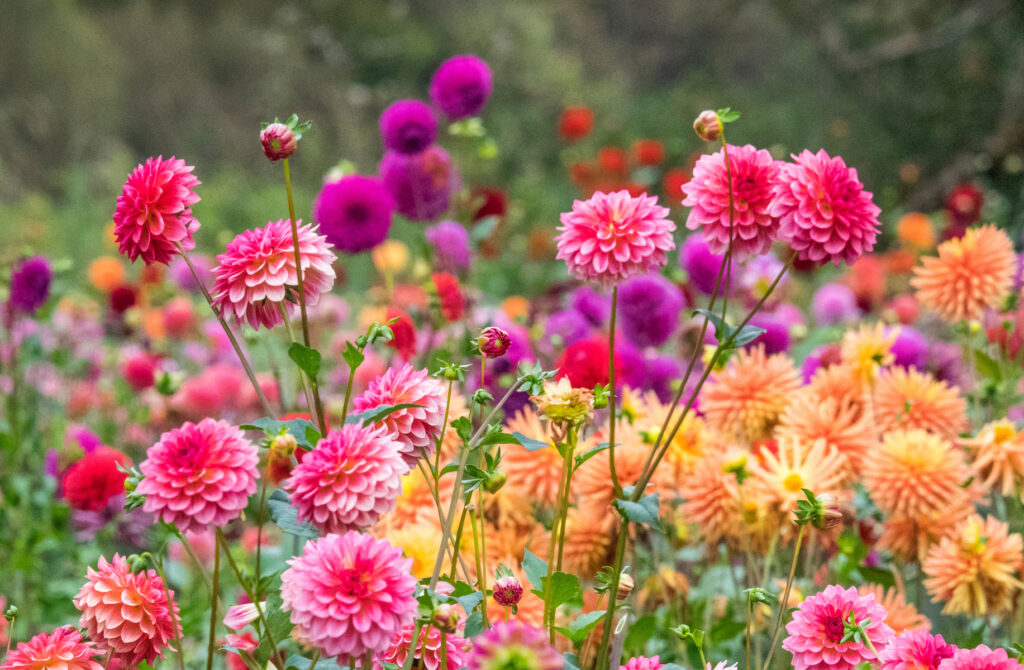
I have a confession. I love dahlias! They are so pretty and come in a size, color, and shape to appeal to anyone! From the 2 inch tightly-packed petals of the lollipop pom pom to the dramatic dinner plate size dahlia, who can resist?
About
Talk about varieties! The genus dahlia belongs to the family of Asterales. There are 42 recognized species of dahlias, and each species can have hundreds of varieties. These showy flowers bloom from mid-summer to late fall in Zones 3-11. They range from 16 to 42 inches tall.
Dahlias originate from Central and South America. Since they originate in areas with warm, dry climates, it makes sense they would grow in rich, well draining soil with plenty of sun. They are considered annuals in Zone 7 and below, although they can be dug up after the first fall frost and stored in a garage (or another cool, dark place) until spring. In Zone 8 and higher, they are considered tender perennials.
Planting
Dahlias prefer slight acidic soil with a pH 6-7.5. The best time to plant is when the soil has reached 60 degrees F and the danger of frost has passed. Dahlia tubers can be started indoors a month ahead of transplanting outside.
Dwarf and medium dahlias will do well in containers. Choose a container that has plenty of drainage holes and is big enough to support the plant at maturity. Generally, a 12 x 12 inch container is sufficient.
Dahlia tubers have three main sections:
- The body which stores food for the plant.
- The eye is the growing point which will sprout and become the stalk of the plant. The eye can get bigger each year, making more growing points.
- The neck connects the eyes and the body.
Tubers that have pink “eyes” (buds) or a little green growth are a sign of a good tuber. Avoid tubers that are wrinkled or rotten.
How to Plant
Dig a hole twice as wide and deep as the tuber, anywhere from 4-6 inches to 6-8 inches deep depending on the size of the tuber. It is helpful to mix compost in the hole but do not fertilize at the time of planting.
When planting a number of dahlias in the same location, they should be separated by about 2 feet to give each plant room to grow. The shorter varieties can be planted closer together, about 9-12 inches. Refer to the specific planting requirements for each variety.
Place the tuber in the hole with the tuber “eye” facing up. Do not break or cut the tuber apart as with potatoes. Cover with soil to the top of the bulb.
As the stem sprouts, cover again with soil until it is at ground level. Covering the stem gradually will allow the stem to strengthen so it can support the flowers. Do not cover with mulch. Dahlias prefer sun on their roots, also, mulch may harbor slugs.
The taller and larger varieties will require support. Install a stake long enough to accommodate and support the mature size of the plant. Protect the plant from high winds as this can cause the stems to break. Plan for rows to be 3 to 5 feet apart depending on the size of the plant. Dahlias begin blooming about 8 weeks after planting.
Watering
Dahlias require moist, well drained soil. If dahlias are planted in soil that doesn’t drain, they can become waterlogged and the tubers are likely to rot.
Do not water tubers at the time of planting as they do not have roots to receive the excess moisture and it could encourage rot. Once the sprouts have appeared above the soil, begin watering. When the plant is established, water 2 to 3 times a week or more in hot, dry climates. Tend to the plant before and after a rain when the plant has open blooms as the blooms can fill up with water or take a beating from the wind.
Dahlias grown in containers will require more regular watering as they will dry out faster. Powdery mildew can be prevented by providing good air circulation and avoiding wetting the foliage at time of watering.
Fertilizing
Dahlias are heavy feeders. Begin fertilizing when the plants are 6 to 12 inches tall with a low nitrogen fertilizer such as a 5-10-10 or 10-20-20 mixture. Fertilize every 3 to 4 weeks to promote continuous blooming, from midsummer to early fall.
If the plant is overfertilized with nitrogen, it may produce small or no blooms, weak tubers or rot.
Maintenance
Dahlias grow best in sun, so aim for 6 to 8 hours of direct sunlight, preferably morning sun and afternoon shade. Usually, the more sun a dahlia receives, the bigger the flowers. If they are planted where they receive too much shade, they may struggle and not thrive.
In warmer climates with lots of sun, dahlias will bloom earlier in the summer than they do in cooler regions. In Zones 8 and above, dahlias may go dormant in the heat of the summer when temperatures reach the 90s. Instead, they may flower in the fall, and again in the Spring. Strong air circulation can help with high humidity.
Individual dahlia flowers may last 4 to 5 days, and in some varieties, up to a week. Dahlia flowers can change as they develop from bud to a mature bloom. Some may change shape while others may change shade, often from deeper to lighter colors.
When a plant is one foot tall, pinch back the center branch just above the third set of leaves. This will encourage a bushier plant, increase stem count and length. For larger blooms, pinch back all side buds only allowing the center one to remain.
To keep a dahlia blooming until late fall, it’s important to deadhead the plant as the flowers fade. When deadheading dahlias, the plants need for seed is frustrated, so it puts its energies into growing more flowers. Continual deadheading can ensure the plant will flower until the onset of winter. This will not only keep a clean appearance, but will help with pest prevention as well.
To deadhead the dahlia, wait until all the petals have fallen from a spent flower. The hard sepal at the base of the flower will close over and what is left looks like a bud. The difference between a bud and a spent flower is that a bud is rounded and the spent flower is cone shaped. Cut back the cone shaped spent flower just above the point where the flower stem joins a main stem. When removing a spent flower, the dahlia will bloom in a week or two.
Harvesting
The more the flowers are cut, the more blooms form. For bouquets, cut stems in the morning before the heat of the day and place in a bucket of cool water. Remove the bottom leaves from the stems and place in a vase of water. Place the vase in a cool spot out of direct sunlight. Check the water level daily, vase life is about 7 days.
Preparing Beds for Winter
In Zone 9 and above, dahlia tubers can be left in the ground. In order to overwinter the tubers, cut the foliage back to just above ground level and cover with several inches of dry mulch or organic matter.
In Zones 3-8, once the foliage is slightly damaged by the first frost, gently dig them up. This should be completed before a hard frost as dahlias do not survive freezing temperatures.
To overwinter dahlias, cut off the damaged foliage, leaving 6 to 8 inches above ground. Carefully, dig around the tuber to avoid damaging it. Clean off the soil and cut off any rotten tubers. Dry the tuber in the sun for a few days with tuber upside down so the water drains from the hollow stems, preventing rot. Once the tubers have dried, the tuber can be dusted with antifungal powder to prevent fungal diseases while in storage. Store in a well ventilated box with loose, fluffy material such as vermiculite, sand, dry soil or compost, or shredded paper. Place in a dark, dry area which does not freeze, ideally 40-45 degrees F, although 35-50 degrees F is acceptable. There is a balance between preventing the tubers from drying out and shriveling versus allowing them to become damp which can promote fungal growth and rotting.
Check occasionally over winter. Remove any rotten tubers before the decay spreads to the other healthy tubers.
Stored dahlia tubers can be replanted once the risk of frost has passed in the spring.
Getting Ready for Summer
In spring, separate the healthy tubers and discard the wrinkled and rotting tubers. Each tuber must have one “eye” on it or it will not develop into a blooming plant.
Pests and Diseases
Maintaining good air circulation and moisture control around plants helps prevent outbreaks.
Pests
Slugs, snails, aphids, borers, thrips, earwigs, caterpillars, nematodes, and spider mites.
Diseases
Wilt, blight, mildew, rot, botrytis blight, southern blight, crown gall, powdery mildew, smut and virus.
Where to Buy Dahlias
The best stock of tubers and plants come from Dahlia growers or specialists. Dahlia societies like the American Dahlia Society have a list of Dahlia growers by state. However, they are also readily available from online nurseries, local nurseries and big box stores.
Dahlias are sold as a single tuber or clump of tubers around a stem. Tuber size and shape vary depending on the variety of dahlia.
Did you know…
The dahlia is named after a Swedish botanist, Anders Dahl.
The Asterales family also includes the Sunflower, Daisy, Chrysanthemum, Zinnia, and Aster.
Dahlias come in all colors except blue. Breeders have tried to create a bluish color through selective breeding and genetic engineering. However, there are no true blue dahlias and they do not exist naturally.